


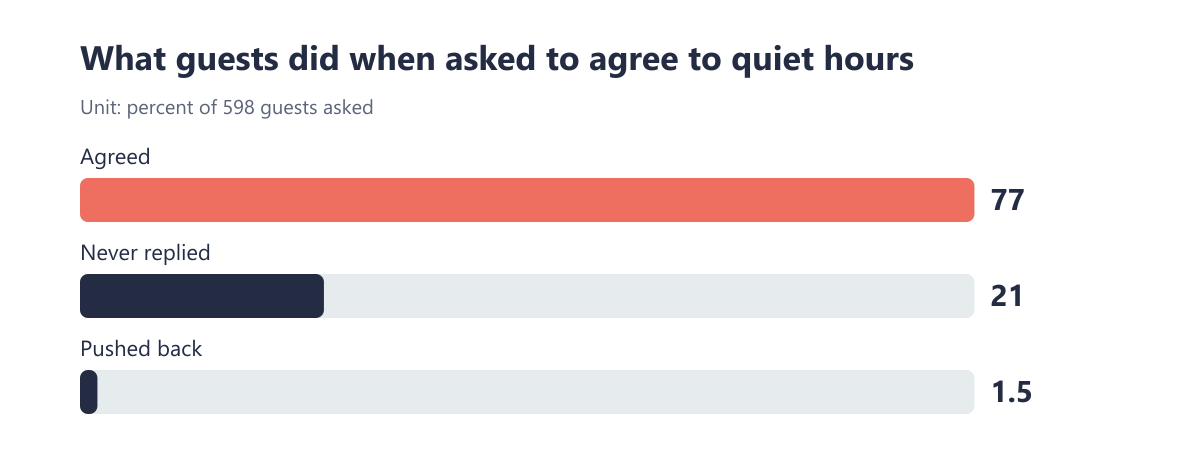
In 1,010 real request conversations from a UK host with over 25 properties, hosts asked guests to agree to quiet hours in 598, and 77% agreed while 21% never replied. Only 9 guests (1.5%) pushed back. So tell guests about quiet hours before you accept, on the bookings where they matter, and wait for a yes. Once you have accepted, it is too late to raise them. If the booking and the first message give you no reason to worry, simply accept: you do not need to question every guest about your house rules.
With notes from Ben McCarthy, who has been hosting in the UK for five years, has more than 25 properties and also cohosts for other hosts.
Should you ask guests to agree to quiet hours?
Yes, on the bookings where it matters, and before you accept. Most guests agreed when asked, and only 9 of the 598 pushed back. You do not need to ask everyone: if nothing about the booking worries you, accept. When something does, such as a group, a one night stay midweek, neighbours in the same building or a plan that points to a lively evening, state the quiet hours first and wait for the guest’s yes. Never accept first and raise them afterwards.
Ben decides it case by case:
“We’re pretty good at spotting red flags based on experience. … We’re a bit stricter if it’s a one night stay during the week, as we have apartments in the same building and we don’t want to upset our other guests. So it all depends on the type of guest.” Ben McCarthy
That is one host’s experience. In the data, the one pattern linked to problem stays was group size, which we come to below.
What happened when hosts asked?
Hosts asked guests to agree to quiet hours in 598 conversations. 77% agreed and 21% never replied. Only 9 (1.5%) pushed back.
What should you do when a guest goes quiet?
When 21% of guests stay silent, you have to decide what that silence means. If the quiet hours mattered enough to raise, silence is not a yes.
Deciding too early is common: 88 decisions were made before the guest had a chance to answer. Meanwhile the request sits open, so speed matters too, as we show in how fast hosts answer requests.
The fix is to decide in advance. Raise quiet hours only on the bookings where they matter, and always before you accept. If the guest goes quiet, send one friendly nudge. If there is still no reply, decline: the guest can request again.
What happens if you decline an Airbnb request?
If you decline, you may turn away a guest who simply has not seen your message yet. This is what Ben does when a guest goes quiet:
“If we’ve been clear with the rules and the guest hasn’t responded, we normally follow up with another message with a couple of hours to go, just to give them a nudge. If they don’t respond, then they’ve probably made a decision themselves that they don’t want to continue with the booking. If so, we reject it, because there’s still an opportunity for them to request again.” Ben McCarthy
He adds that this is not the end of the world when the stay is a couple of months away, because the guest can book again. A last minute booking is different.
How strict should Airbnb quiet hours be?
Firm where the booking gives you a reason, and light everywhere else.
When is asking for agreement worth it?
When the booking points to a lively evening. Group size was the only pattern linked to problem stays: stays of 4 or more guests were 31% of all stays but 63% of the 19 clearest behaviour problems, and noise was among the most common problems reported. The full picture is in what predicts a bad stay. There is more on noise complaints in a separate post.
The guest’s own words tell you most. In a replay of past requests, the signs that mattered were in what guests wrote: drinks at the property, a late return inside quiet hours, a guest count that kept changing, local friends calling round. So ask for a clear yes, before you accept, when the guest mentions:
- a celebration or a party weekend
- a late return, such as a gig or a night out
- friends calling round to the property
- a group of four or more heading out for the night
A guest count that keeps changing needs its own question. We cover it in guests who book for fewer people than arrive.
A clear yes is a record that the rules were understood before arrival. It is a paper trail, not a guarantee.
A celebration on its own is not a reason to turn a guest away. In that replay, a strict rule set would have declined 138 requests the team accepted. The biggest single reason was a celebration where the guest agreed to the house rules and the stay was fine (40). More in would stricter guest rules have helped.
When can you simply accept?
When the booking and the first message give you no reason to worry. There is no need to question every guest: for most guests, a noise agreement can feel like an accusation. Let the plan in the booking guide you, never a guest’s age or any other personal trait.
How do you word it so good guests are not put off?
Keep it short and give a reason. A reason sounds like a courtesy. A bare rule sounds like a warning.
A method that names the one doubt about a booking and asks only that settled 19 of 40 of the hardest cases, asked less than the hosts did in 26, and no offended guest was found. It is a small test, so treat it as a sign, not proof.
Before you accept, when quiet hours matter for the booking:
“Lovely, thanks for your request. Before I accept, just so you know, it’s a residential building, so we keep things quiet late in the evening. Could you confirm you’re happy with that? Then I’ll get you booked in.”
An agreement, for a group heading out for the night:
“Sounds like a great night out. As the building is residential, we ask for the volume to stay down when you’re back late, and only the guests on the booking staying over. Does that work for your group?”
A friendly nudge, if they go quiet:
“Just checking you saw my last message. Once you’re happy with the quiet hours, I’ll get you booked in.”
Key numbers
What to do with this
- Accept when nothing worries you. If the booking and the first message give you no reason to worry, accept, and keep your quiet hours, with a short reason, in your guidebook.
- When quiet hours matter, say so before you accept. Base it on the plan, not the person: celebrations, late returns, friends calling round, group nights out. Wait for the guest’s yes, because once you have accepted it is too late.
- Decide in advance what silence means. If the quiet hours mattered enough to raise, silence is not a yes.
- Give the guest a chance to reply. One friendly nudge, then decline if there is still no answer. The guest can request again.
Limits of this data
- Each conversation was judged from its text alone. The hosts could also see the guest’s profile.
- The incident numbers are small: one stay moves a share by several points.
- The team chats record what was noticed, not everything that happened.
- Group size is counted from the number booked. Guests often book for one or two and bring more, so the true link between group size and trouble is likely stronger than shown.
- The replay used one reading of one host’s rules, judged by an AI model. “Fine” means no problem was reported in the team’s own chats.
Zugrow is a channel manager for Airbnb and Booking.com hosts, with a Guest Vetting agent built in. Guest Vetting checks each request against your house rules and recommends accept, ask or decline, with its reasoning shown, so you can see what is unclear before you decide. Declining a guest always waits for you. Join the waitlist.