


By Ben McCarthy, who has been hosting for five years, has more than 25 properties in the UK and also cohosts for other hosts.
Requests made within 3 days of arrival were accepted in a median of 82 minutes. Requests made further ahead took about 3 hours. Of 3,472 requests with a final outcome, 7% expired, which means the guest did not stay and nobody ever decided they should not.
Every booking request needs a decision from the host. This article looks at how fast hosts made that decision, and what happened to the requests that never got one.
The data comes from a UK host with over 25 properties: 9,195 bookings and requests, plus 1,010 real request conversations judged case by case by an AI review.
How fast do hosts accept a booking request?
Speed depended on how close the stay was.
- Requests made within 3 days of arrival were accepted in a median of 82 minutes, and 8% were declined.
- Requests made further ahead were accepted in about 3 hours, and 12% were declined.
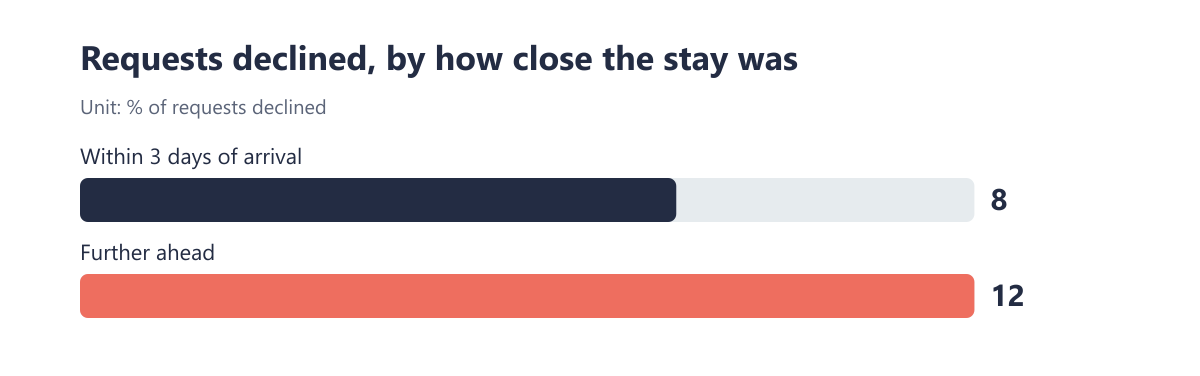
A request for this weekend feels urgent. A request for next month feels like it can wait. The further ahead the stay, the slower the answer.
This is how Ben handles requests day to day:
“We like to respond within the first hour to a request, because that gives us time to then ask a few more questions before making a decision. If we’ve not had any decision from someone, we normally give them a nudge after about 6 hours, or if it’s been night time, we’ll give them another nudge in the morning. And we normally reject it a few hours before the request is about to expire.” Ben McCarthy
What a request can tell you about the guest is a separate story, told in what an Airbnb request tells you.
How many requests run out with no answer?
About four in ten of the 9,195 bookings and requests arrived as a request rather than an instant booking. Each one needs a decision from the host.
Of the 3,472 requests that reached a final outcome, 10% were declined and 7% expired.
What happens if you don’t respond to an Airbnb request?
It expires. An expired request got no decision at all: the guest did not stay, and nobody ever decided they should not.
Even before that point, Ben sees a cost in the wait:
“I just think it doesn’t look great if someone’s requested to book and it’s taken hours for them to approve, because these people, you know, want to book their train and they’ve got other plans that they want to do, and it doesn’t get off to the best start if they’re still waiting 12 or 15 hours for you to make a decision, which could later affect your reviews.” Ben McCarthy
Our guide to response time and Airbnb ratings looks at the review side.
What happens if you decline an Airbnb request?
A decline at least is a choice, and the guest is not left waiting. For a last minute request on the day itself, Ben keeps the wait short:
“…it’s on the day and we want to fill that day, then we tend to give them a few hours and then reject, so it can free up that night for someone else to try and book.” Ben McCarthy
Are most requests worth the wait?
Most are not hard calls at all. When an AI review judged the best first reply in each of the 1,010 conversations, its judgement was:
- accept at once in 42%
- accept, with the house rules stated, in 29%
- ask one question in 16%
- ask the guest to agree to the rules first in 9%
- decline in 4%
That split is the review’s judgement, not this article’s advice. Ben’s own rule is this. If the booking and the first message give you no reason to worry, accept, and do not leave the request sitting in the inbox. If quiet hours or another house rule matters for the booking, for example a group, a one night stay midweek, neighbours in the same building or a celebration, say so before you accept and wait for the guest’s reply. Never accept first and raise it afterwards: once you have accepted, it is too late.
The harder calls are the subject of a replay of past requests against stricter rules.
What slows hosts down?
Questions to the guest add a wait for a reply.
Hosts asked “who is staying” 578 times and “what brings you here” 504 times. About one in seven of those questions could have changed the decision. The full picture is in do pre booking questions work.
Asking guests to agree to quiet hours is the other common question. Hosts asked in 598 conversations: 77% agreed and 21% never replied. Quiet hours: ask or tell looks at when to raise them, always before you accept.
Can a host answer too fast?
Yes. 88 decisions were made before the guest had a chance to answer. Speed helps on the easy requests. On a request where the host has a real doubt and has asked about it, deciding before the guest can reply throws away the answer the host asked for.
The aim is not to rush every request. It is to answer the clear ones at once, and to give the unclear ones a fair, short chance.
Key numbers
What to do with this
- Answer every request the same day. Treat a request for next month with the same urgency as one for this weekend. Whether a request comes from Airbnb or Booking.com, seeing both in one calendar helps you weigh it against what is already booked.
- Read the booking and the guest’s message first. If the guest count, the reason for the stay and the dates already line up, there is nothing to ask.
- Say yes at once to the clear ones. They are the most common kind of request.
- If a house rule matters for this booking, say so before you accept. For example a group, a one night stay midweek, neighbours in the same building or a celebration. Wait for the guest’s reply: once you have accepted, it is too late.
- If you need to ask, ask one specific question about the gap you can see, such as a booking for one when the message mentions a group.
- Give the guest a fair chance to reply. Send one short nudge if there is no answer. If there is still no reply, decline before the window closes: the guest can request again.
- Decide on the guest’s plans as they describe them. Never on age, family, nationality, language or any personal trait.
Limits of this data
- Judgements, not facts. The “best first reply” for each conversation is an AI review’s judgement, made from the conversation alone. The hosts could also see the guest’s profile, which the judging could not.
- Small numbers for problem stays. Problems after a stay were rare, so one stay can move a share by several points.
- Team chats are not a full record. Problems were taken from the team’s own chats, which record what was noticed, not everything that happened.
- Group size is counted from the number booked. Guests often book for one or two and bring more, so the true link between group size and trouble is likely stronger than the booked figures show.
- Totals only. No guest names, messages, property names or stay dates are published.
Where Zugrow fits
Most requests are an easy yes, so the cost is in the wait. Zugrow’s Guest Vetting agent checks every booking request against your house rules and the stated party size, the same way each time, even while you sleep, and recommends accept, ask or decline with its reasoning shown. Declining a guest always waits for you. The Inbox agent can answer around the clock in your voice. Join the waitlist.