


Across 5,685 stays at a UK host with over 25 properties, group size was the only pattern that lined up with bad stays. Stays of 4 or more guests were 31% of all stays but 63% of the 19 clearest guest behaviour problems. One night stays, weekend nights, last minute bookings and requests showed no clear link.
About the author: Ben McCarthy, a UK host with over 25 properties who has been hosting for 5 years and also co hosts for other hosts.
Hosts watch for warning signs: one night, a Saturday, booked tomorrow, a request instead of an instant booking. We matched one business’s problem reports to its bookings to see which signs really lined up with bad stays.
Where do these numbers come from?
The source is a UK host with over 25 properties, most sleeping 4 to 8 guests. Its team reports problems in two group chats, about 11,800 messages in all, covering roughly 18 months.
We matched those reports to bookings. 73 different bookings were matched to a reported problem: 20 from one chat, 56 from the other, and 3 that appear in both. That is out of 5,685 stays, so problems were a small share of all stays.
From those, we took the 19 clearest cases of guest behaviour going wrong and compared them with the stays as a whole.
Does group size predict a bad stay?
Yes, in this data it was the one pattern that held. Larger groups had far more than their share of the clearest problems. Small groups had far less.
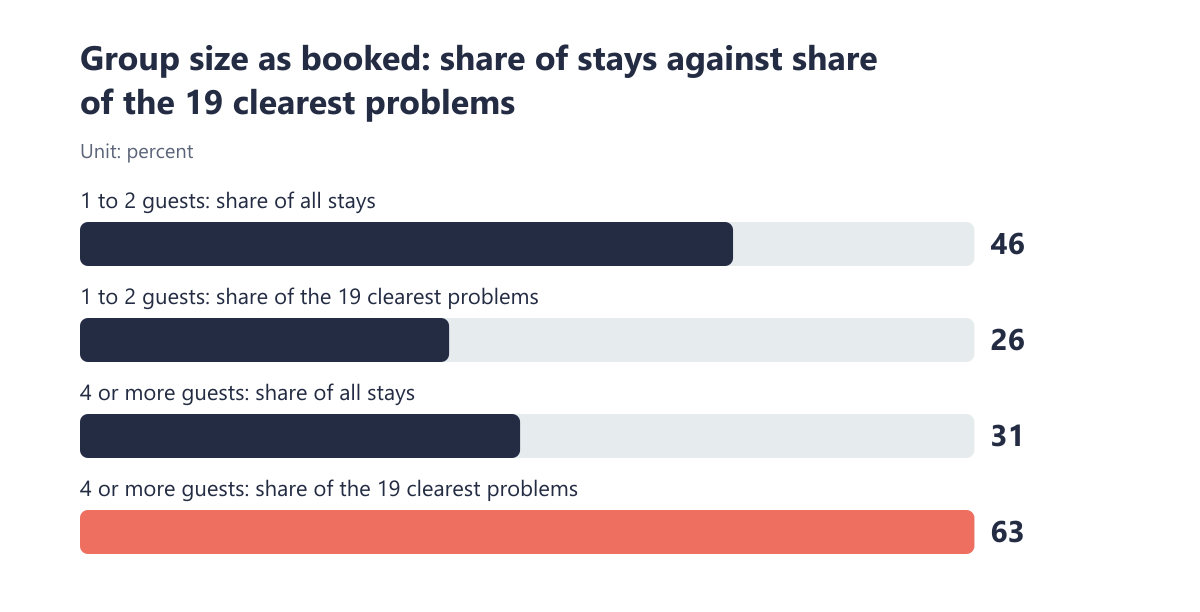
One twist means the real link is probably stronger, not weaker. Group size is counted from the number on the booking, and guests often book for one or two and bring more. So some problem stays in the “1 to 2 guests” row were really larger groups. The true link between group size and trouble is likely stronger than the table shows.
That gap between the booked count and the real count is common. In 92 of 1,010 request conversations (9%), more people were coming than were booked. We look at those guests, and what to ask them, in guests who book for fewer people. In the problem reports, several of the worst stays were also more people than booked.
Hosts here already lean this way. Requests were declined 8% of the time for 1 to 2 guests, 9% for 3 to 4 guests, 15% for 5 to 6 guests and 19% for 7 or more.
Which red flags showed no clear link?
Four signs that hosts often worry about did not line up with the problem stays in this data.
Are one night stays riskier?
Not in this data. Hosts were warier of them: one night requests were declined 11% of the time, against 7% for two nights and 7% for three to six nights. Yet one night stays did not stand out among the problems.
Asked whether he used to worry about one night and weekend bookings, and whether he still does, Ben said:
“Yes, we’re always cautious with any of those. We have instant book, but only for guests with a good track record. … Whereas if no one’s ever stayed on Airbnb before, we’re a lot more cautious.” Ben McCarthy
That caution shows in the decline rates above. The problem reports are a separate question, and there one night stays did not stand out.
Are weekend nights riskier?
Weekend nights carry a reputation, but they showed no clear link to problems here.
Are last minute bookings riskier?
Requests made within 3 days of arrival were declined 8% of the time. Requests made further ahead were declined 12% of the time. Even so, late bookings showed no clear link to the problem stays.
Is a request riskier than an instant booking?
About four in ten bookings arrived as a request rather than an instant booking. Requests showed no clear link to problems either. What a request does and does not tell you about the guest is covered in what an Airbnb request tells you.
A word of care: “no clear link” is not the same as “no effect”. With 19 cases, a small effect could hide.
What goes wrong most often?
The problems reported most often were damage, a property left very dirty, noise, smoking and late checkout. Several of the worst were stays with more people than booked.
Asked what predicts a bad stay, Ben pointed to a full property booked for one night:
“So if you’re at maximum capacity, if you’ve got, for example, a place that can sleep six and there’s six of them all staying and it’s just for one night, you’re likely to have problems with that.” Ben McCarthy
That joins two signs: a large group and a single night. In the numbers above, group size lined up with problems and one night stays did not stand out. This article does not report full properties booked for one night as a group of their own, so the data can neither confirm nor rule out that pairing.
What are red flags for Airbnb guests?
In this data, one sign stood out: the number of guests. Here is what to do with that.
- Read the count on every booking. Compare the number booked with what the guest says. Group size is the clearest signal in this data.
- Ask one clear question only when the count is unclear. Name the number on the booking: “The booking shows one guest. How many of you will be staying?” If more people are coming, ask the guest to update the booking. For more on which questions are worth asking, see do pre booking questions work.
- Give larger groups a closer read, not an automatic no. Check the count and make the house rules clear. For how to put quiet hours across, see quiet hours: ask or tell.
- Do not treat one night, a weekend or a late booking as a red flag on its own. Start with the count. For what happened when past requests were replayed against stricter rules, see would stricter guest rules have helped.
- Log your own problems against bookings. A simple record of what went wrong, and on which stay, turns gut feeling into evidence.
Limits of this data
- The problem numbers are small. With 19 clear cases, one stay moves a share by several points.
- Team chats record what was noticed, not everything that happened.
- The two chats were never checked for repeats, so we count different bookings (73), not reports.
- Group size is counted from the number booked. Guests often bring more people than they book, so the group size link is likely understated.
- Request figures cover 7 Apr 2025 to 2 Oct 2026: 9,195 bookings and requests, of which 3,472 requests had a final outcome.
Where Zugrow fits
Zugrow is a channel manager for Airbnb and Booking.com hosts. Its Guest Vetting agent reads each booking request and recommends what to do, and it checks with the guest how many people are staying, the one sign that stood out in this data. A decline always waits for the host. Join the waitlist.