

In 1,010 real booking request conversations from a UK host with over 25 properties, more people were coming than were booked in 92 of them (9%). Those requests were declined 23% of the time, against 8% when the guest’s numbers matched the booking. One short question that names the number on the booking is a simple way to sort it.
The number on a booking is the number you plan for. It sets the beds, the towels, the clean and the noise the neighbours will hear. When the real group is bigger, every one of those plans is wrong before the guest arrives.
About the author: Ben McCarthy is a host with more than 25 UK properties. He has been hosting for five years and also cohosts for other hosts. His own experience sits alongside the data below.
How often do guests bring extra people?
We looked at 1,010 booking request conversations from a UK host with over 25 properties. Each one was judged case by case, from the conversation alone.
In 92 of them (9%), more people were coming than were booked.
What happens if a guest brings more people to an Airbnb?
In this data, the host declined 23% of the requests where more people were coming. Where the numbers matched, the host declined 8%.
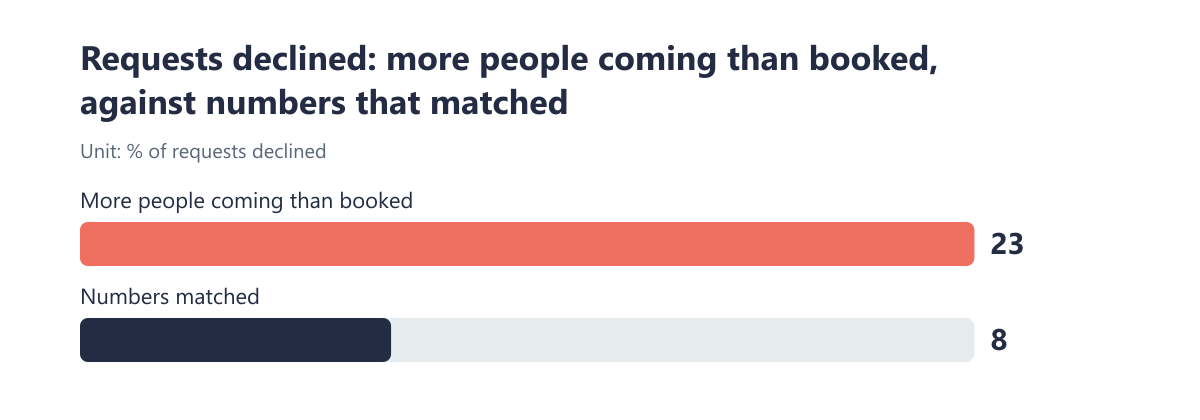
So a gap between the booking and the guest’s words came with a much higher decline rate. That does not mean every one of those guests was a problem. It means the gap made the host stop and think.
Why is the booked number so often wrong?
Guests often book for one or two and bring more. The booked number is what the guest typed in, and it is the only number you can see before you reply. For what else a request can and cannot tell you, read what a booking request really tells you.
Why does the real group size matter?
Group size was the only pattern in this data linked to bad stays. Stays of 4 or more guests were 31% of all stays but 63% of the 19 clearest behaviour problems. Several of the worst problems were more people than booked.
Those group sizes are counted from the number booked, not the number who came. Guests often book for one or two and bring more, so the true link is likely stronger than these figures show. The full picture, and the things that showed no clear link, is in what predicts a bad stay.
What are red flags for Airbnb guests?
Two signs in this research point at numbers. The first is the group size above. The second is a guest count that kept changing, which was one of the real warning signs when we replayed past requests against stricter rules. You can read more in would stricter guest rules have helped.
A count can also be right and still miss the point. Ben once asked a guest to confirm the number of guests staying over. The guest said, correctly, that three people were staying over. What the answer left out was a group of people coming during the stay for a party and a gathering, without staying overnight. It turned out to be a whole hockey team, there for pre drinks. It was a bad stay. Since then he asks a wider question:
“Can you confirm the total guests that will be staying at any time?” Ben McCarthy
In his words, it is good “to vet your guests properly first and make sure you’re saying the right stuff, because people will try and talk their way around things.”
What should I ask when the numbers do not match?
Hosts in this data asked “who is staying” 578 times and “what brings you here” 504 times. About one in seven of those questions could have changed the decision.
In the hardest cases, a method that names the one doubt and asks only that settled 19 of 40 in a small test, asked less than the hosts did in 26, and no offended guest was found.
So the question earns its place when the booking and the guest’s words disagree. One way to word it is to name the booked number, so the guest sees the gap at once:
“The booking shows two guests. How many of you will be staying?”
If the guest has already hinted at a number, offer it back so they only need to say yes. If visitors or a celebration come up, cover the whole night:
“Will it be just the group on the booking, with nobody else back at the apartment? If so, please update the booking to the full number and I’ll approve it.”
When the numbers do not match, Ben leads with the practical reason, the towels and the beds:
“Our cleaners need to know how many people to provide for, otherwise we can’t provide enough towels and set up the beds properly. Can you just confirm the total number of guests that will be staying at any time so we can accommodate for this?” Ben McCarthy
If he is still unsure, for example with a birthday or a graduation, he makes it clear before accepting that the property does not accommodate parties. The care is in the tone:
“It’s just that you’ve got to find a way of being polite and not upsetting the guest… It doesn’t always feel great to make them feel like you presumed they would be bad.” Ben McCarthy
The answer is not an automatic no. What matters is the plan for the stay and the real number of people, not who they are. For more on which questions are worth asking at all, see do pre booking questions work.
What to do with this
- Read the booked number against the message before you reply. If they match and nothing else about the booking worries you, skip the question and accept. If your Airbnb and Booking.com messages arrive in one inbox, make this the first check on every request.
- If they differ, ask one short question that names the booked number.
- If no number is given, look at the booking and the plan first. Ask only when something in the message suggests a bigger group or visitors.
- Ask the guest to update the booking, so the real number is on record.
- Give the guest a fair chance to reply before you decide.
- Decide on the plan and the real group size, never on age or any other personal trait. Our guide to guest screening covers the legal side for UK hosts.
Limits of this data
- The 1,010 conversations were judged case by case from the conversation alone. These are judgements, not facts, and the hosts could also see the guest’s profile.
- The problem figures are small. With 19 clear problems, one stay moves a share by several points, so treat the group size link as a strong hint, not proof.
- The team chats behind the problem figures record what was noticed, not everything that happened.
- Group size is counted from the number booked. Because guests often book for one or two and bring more, the link between group size and trouble is likely stronger than the figures show.
Where Zugrow fits
Zugrow is a channel manager for Airbnb and Booking.com hosts, and its Guest Vetting agent reads each booking request and recommends accept, ask or decline, with its reasoning shown. It checks each request against your house rules and cross-checks the stated party size, the same gap this article looks at. Declining a guest always waits for you. Join the waitlist.