


Mostly not. When 1,419 past requests at a UK host with over 25 properties were judged again against a strict set of rules, the rules would have turned away 138 requests the team accepted, and 107 of those stays went ahead with no problem recorded. When the strict rules were right, the warning sign was in what the guest wrote, not in the shape of the booking.
About the author: Ben McCarthy is a UK host with over 25 properties who has been hosting for 5 years and also co hosts for other hosts. His own view sits alongside the data below.
Many hosts feel they should be tougher. Say no to big groups. Say no to celebrations. Hold out for a better guest when the dates are far away. We wanted to know what that would really change, so we replayed real requests against strict rules and checked what happened to the stays.
How was the test run?
A host wrote down the rules they would use on a cautious day:
- A group of four or more is a concern.
- Sunday to Thursday nights are work nights.
- When the stay is far ahead, wait for a better guest.
- A celebration raises the risk.
We took 1,419 past requests that came with the guest’s messages and judged each one again against those rules. The judge was meant to see only what the host knew just before deciding, never how the stay turned out. For about half of the requests the team declined, the conversation still held the team’s own turn down message, which gives the answer away, so those are left out of the count (the limits at the end explain why). The figures for accepted requests are not affected.
The team had accepted 1,259 of these requests (89%) and declined 160 (11%).
Asked which of these rules he really uses, Ben put it this way:
“I prefer to use strict because I like that it always checks the reason for the stay politely, and it also confirms the numbers. … the guest vetting is able to just clarify the right number of people. And this is useful because our cleaners depend on that to know how many towels to leave out, as well as other things like you can see if this guest is contradicting themselves.” Ben McCarthy
Being strict, in his hands, means asking about the reason for the stay and the number of people. Keep that in mind as you read the results.
Did the strict rules agree with the team?
Mostly, yes. The strict rules agreed with 82% of the team’s accepts. They were unsure on 7%. They would have declined 11%, which is 138 requests the team said yes to.
On the requests the team declined, we can only fairly count 81 (see the limits below). The rules declined 37 of those 81 (46%). So the strict rules were not simply a tougher version of the team. They disagreed in both directions.
Which guests would the strict rules have turned away?
Larger groups, above all. The rules would have declined 1 in 4 of the groups of four or more that the team accepted: 124 of 499.
Group size does matter. In this business it was the one pattern that lined up with bad stays, as covered in what predicts a bad stay. The next sections show what happened to the stays the rules would have refused.
What happened to the stays the rules would have refused?
This is the key number. Of the 138 requests the rules would have turned away but the team accepted:
Only 3 of the 138 had a problem recorded. Across all 1,259 accepted requests, 11 problem stays were reported, under 1%.
What set the strict rules off?
We looked at why the rules flagged those 138 requests:
- A celebration, where the guest agreed to the house rules and the stay was fine: 40.
- A group booking far ahead with no other sign: 34.
- An ordinary plan read too strictly: 23.
- Real warning signs in the guest’s own words: 18.
- Other: 23.
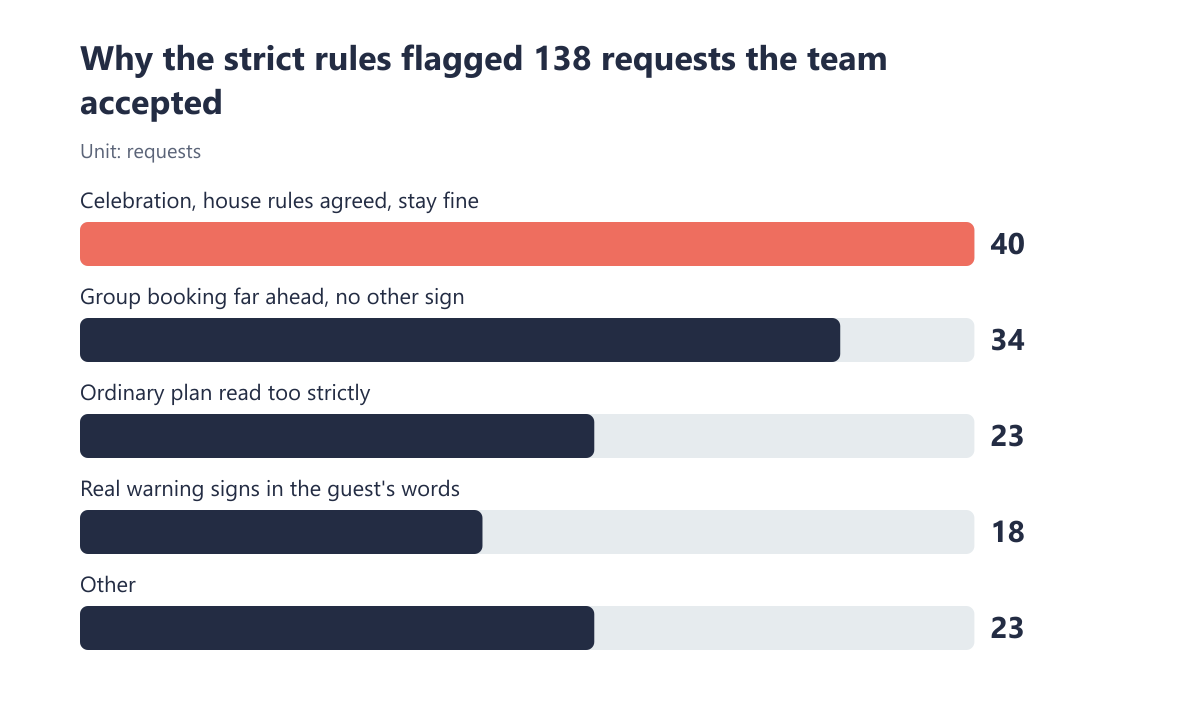
Most of the time the rules reacted to the shape of the booking. A birthday. A group. Dates a long way off. Those things alone did not mark out a bad stay.
Ben on celebration bookings:
“A birthday for couples where it’s just that couple, which is why it’s good that the guest vetting will just clarify with them first, is it just you two? Because that’s completely different to a party. If there was 6 people coming for a birthday, then guest vetting would treat that completely differently.” Ben McCarthy
What are the red flags for Airbnb guests?
In this replay, the strict rules were right when the guest’s own words gave it away. The signs that mattered were things like:
- Drinks planned at the property.
- A late return inside quiet hours.
- A guest count that kept changing.
- Local friends calling round.
None of these show up in the booking details. You only see them by reading the messages. A count that keeps changing is worth a closer look; see guests who book for fewer people.
Can you judge a request from the booking details alone?
Not well. We also ran the rules on a further 1,658 requests with no saved messages. On the booking details alone, the rules could not decide on about 7 in 10 group requests. The guest’s words settle it.
For what the request itself can tell you, see what an Airbnb booking request tells you.
How do you screen Airbnb guests?
Here is what this replay suggests.
- Read the guest’s words first. The useful signs were in the messages: drinks at the property, late returns, a changing count, friends dropping by.
- Ask for agreement to the house rules. A celebration where the guest agreed to the house rules was the biggest group of false alarms, and those stays were fine. A short message works: “Thanks for your request. Could you confirm you are happy with the house rules, including quiet hours?” For whether to ask or simply state quiet hours, see quiet hours: ask or tell.
- Be slow to refuse on the shape of a booking alone. A group, a birthday or dates far ahead are reasons to read closely and ask one clear question, not reasons to say no. Asking takes a little time, and how fast hosts answer requests looks at what waiting costs.
- Ask about what you cannot see. If the messages say little, ask what brings them to the city and who is staying. For which questions tend to settle a request, see do pre booking questions work.
Limits of this data
- Team chats record what was noticed, not everything that happened.
- Group size is counted from the number booked. Guests often book for one or two and bring more, so the true link between group size and trouble is likely stronger than it looks here.
- “No problem recorded” means none was reported in the team’s own chats. It does not prove nothing went wrong.
- The rule set is one reading of one host’s rules. Other strict rules could give different results.
- The judging was done by an AI model reading the conversation, not by the host.
- In about half of the requests the team declined, the conversation the rules saw still held the team’s own turn down message, which gives the answer away. So for declined requests we count only the 81 where that message was not there. The figures for requests the team accepted are not affected.
- 28 of the 138 were cancelled before the stay, so nothing is known about how those stays would have gone.
Where Zugrow fits
Zugrow is a channel manager for Airbnb and Booking.com hosts, with a Guest Vetting agent built in. It reads each booking request, checks the reason for the stay and the number of guests, and recommends what to do. That is the approach this replay supports: read the guest’s words and ask before you refuse. Declining a guest always waits for you. You can compare plans on our pricing page. Join the waitlist.