

What the September 2026 Bristol Market Data Tells Us About Post-Festival Pricing
The Harbour Festival has packed up, the crowds have dispersed, and Bristol's short-term rental market has settled into its September rhythm. For hosts running 2-bedroom properties in the city, this transition period is where pricing discipline separates full calendars from empty ones.
AirROI market data for October 2026 shows Bristol 2-bedroom entire homes averaging £151 per night with 51% occupancy, producing a revenue per available night (RevPAR) of £73. Across 12 active listings in the Broadmead sample, the average booking lead time sits at 52 days, with guests staying an average of 4.2 nights.
Those figures reveal a market in flux. September isn't peak season, but it isn't dead either. The challenge: how do you price the demand tail without leaving money on the table or scaring off the business travellers, relocating families, and late-summer city breakers who are still searching?
Bristol Airbnb September Pricing: The Numbers Behind the Market
Let's break down what the data is actually showing, because the headline average daily rate doesn't tell the whole story.
| Metric | Bristol 2-Bed (September 2026) |
|---|---|
| Average Daily Rate | £151 |
| Occupancy Rate | 51% |
| RevPAR | £73 |
| Average Booking Lead Time | 52 days |
| Average Length of Stay | 4.2 nights |
| Active Listings (Sample) | 12 |
Source: AirROI market data, October 2026 (Broadmead, Bristol, 2-bedroom entire homes)
The £151 average daily rate is higher than many hosts expect for September. That's not a fluke. Bristol still pulls business travel, university visits (parents scouting accommodation for next year, postgrads settling in), and tourists chasing lower prices and thinner crowds after the school holidays.
But 51% occupancy tells you the market isn't frictionless. Half your calendar is empty. Zugrow's free listing score regularly surfaces occupancy gaps like this, where the pricing is defensible but the calendar strategy isn't. For more on how occupancy and pricing interact, see our guide on how occupancy rate changes your price.
Why Bristol Airbnb Occupancy in September Hovers Around 50%
September occupancy of 51% isn't a sign the market has died. It's a sign the market has segmented, and your pricing needs to segment with it.
Peak summer demand has evaporated, but demand hasn't disappeared. You're now competing for:
- Business travellers: contractors, consultants, and relocating professionals who need a base for the week. Average length of stay of 4.2 nights (AirROI market data, October 2026) fits this profile perfectly.
- University-adjacent bookings: parents visiting students, academic conferences, prospective postgrads viewing the city.
- Late-summer leisure: couples and small groups chasing cheaper rates and quieter streets after the school term starts.
The mistake: treating September like August with a discount. August is families. September is professionals and planners. Their booking windows, price sensitivity, and search filters are completely different.
That 52-day average booking lead time (AirROI market data, October 2026) is the giveaway. These aren't impulse bookings. They're searching 7-8 weeks out, filtering by workspace, WiFi speed, parking, and location. If your listing doesn't surface in those filtered searches because you haven't ticked the right amenities, you're invisible regardless of price.
How to Price Bristol 2-Bed Airbnb Rates for the September Tail
The £151 average daily rate is a market aggregate, not a target. Your rate depends on where your listing sits in the pecking order: location, amenities, reviews, responsiveness, and calendar availability.
1. Split Your Weeknight and Weekend Pricing
Business travel dominates September weeknights. Leisure travel dominates weekends. If you're running a flat rate across the week, you're either overpricing Monday to Thursday or underpricing Friday and Saturday.
A sensible September split for a well-reviewed 2-bed near Broadmead or Clifton might look like:
- Monday to Thursday: £140-£155 (target the corporate and contractor segment)
- Friday to Sunday: £165-£180 (capture leisure and short-break demand)
If your occupancy is below 45%, your weeknight rate is probably too high. If your weekend nights are booking out but weeknights aren't, you've got the balance wrong. Zugrow's Autonomous Pricing agent adjusts nightly rates dynamically based on forward demand, so you're not guessing every Monday morning.
2. Use Multi-Night Discounts to Lift Average Stay
The 4.2-night average length of stay (AirROI market data, October 2026) is a revenue gift if you structure your discounts correctly.
A 3-night minimum at weekends with a 10% weekly discount pulls longer bookings without tanking your revenue. Example:
- Single night: £170
- 3-night weekend: £153/night (10% off)
- 7-night stay: £144/night (15% off)
You've traded a small per-night margin for calendar certainty and lower turnover costs. One 7-night booking beats two 3-nighters once you account for cleaning, linen, and the time cost of check-in coordination.
3. Tighten Your Minimum Stay for Last-Minute Gaps
With a 52-day average booking lead time (AirROI market data, October 2026), anything within 14 days is effectively last-minute inventory. Drop your minimum stay to 1 night and your rate by 10-15% to capture spontaneous demand.
This isn't discounting. It's yield management. An empty night earns you £0. A £120 last-minute booking earns you £120. The maths is brutal but simple.
What RevPAR of £73 Actually Means for Your Monthly Revenue
Revenue per available night (RevPAR) is the only metric that matters when you're comparing performance across time or against competitors. It's your average daily rate multiplied by your occupancy rate, so it captures both pricing power and calendar fill.
Bristol 2-bed properties are generating £73 per available night in September 2026 (AirROI market data, October 2026). Across a 30-day month, that's £2,190 in gross rental income before cleaning fees, service charges, and costs.
That figure is an average. If your listing is better than average (higher review count, better photos, faster response time, premium location), you should be above £80 RevPAR. If you're below £65, something is broken: your pricing, your listing optimisation, or your calendar strategy.
Zugrow's free listing score shows you exactly where you sit in the local pecking order and which fixes move the needle. For a deeper dive into Bristol's competitive landscape, see our Bristol market deep dive.
The Real Reason Your Bristol Listing Isn't Booking in September
If your occupancy is below the 51% market average (AirROI market data, October 2026), price is rarely the only culprit. More often, it's a combination of:
Missing or Poorly Positioned Amenities
September demand skews professional. That means filtered searches for workspace, WiFi, parking, and coffee facilities. If you don't have these amenities ticked on Airbnb, you don't appear in those searches, full stop.
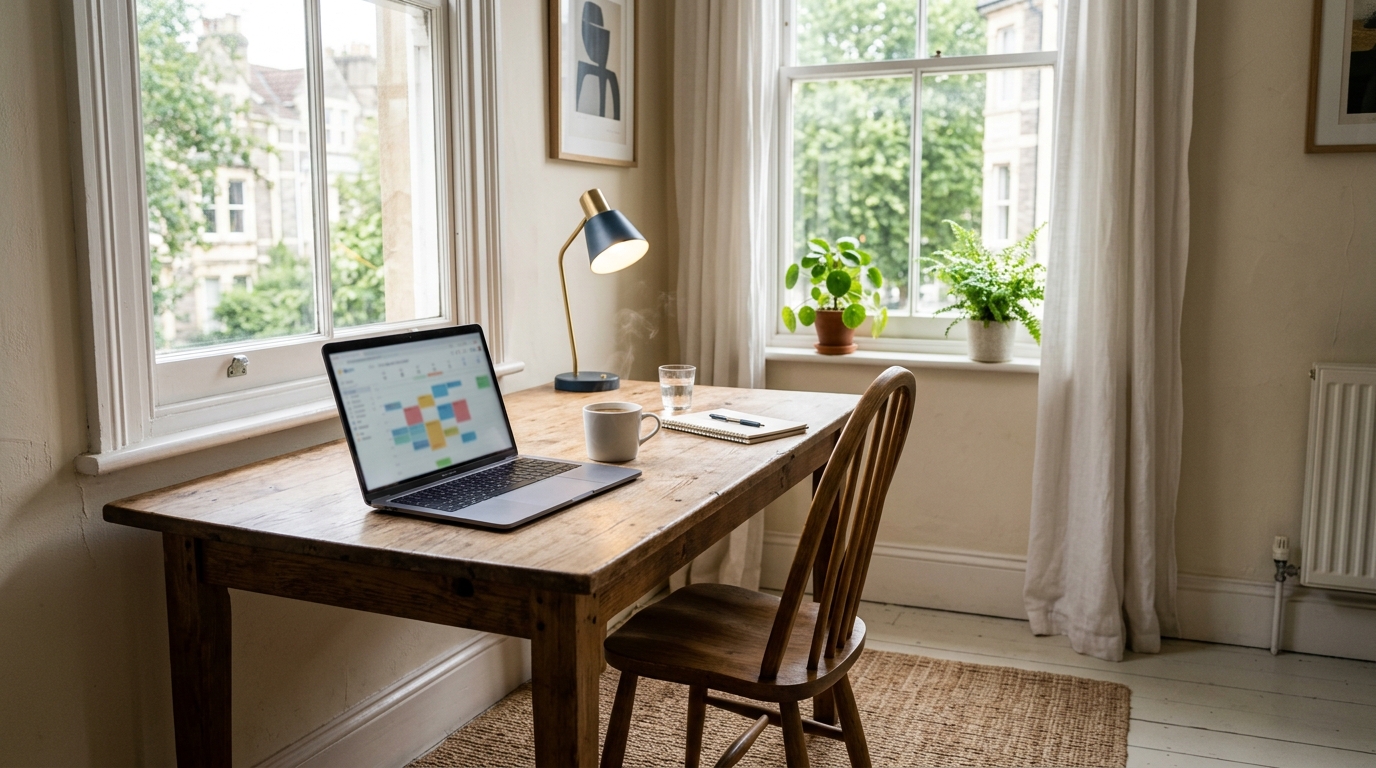
A cheap cafetière (£10-£20) qualifies as a 'Coffee Maker' on Airbnb's amenity checklist. Tick it. A dining table with a chair and a reading lamp qualifies as a 'Dedicated Workspace'. Tick it. Free on-street parking within 200 metres qualifies as 'Free Street Parking'. Tick it.
These aren't upsells. They're table stakes for September business travel demand.
Photos That Don't Reflect September Search Intent
Your hero photo should be the room or feature that matches the dominant search intent for the month. In September, that's workspace, kitchen (for longer stays), or a calm, uncluttered living area that signals 'I can work here in peace'.
If your hero shot is a summer balcony or a crowded sofa styled for a family, you're signalling the wrong season and the wrong guest. Zugrow's AI photo enhancement can sharpen, brighten, and reframe your existing shots without a reshoot, from 47p per photo (the first ten photos 99p each).
Instant Book Turned Off
With a 52-day booking lead time (AirROI market data, October 2026), corporate bookers and planners are comparing dozens of properties. Instant Book is a filter checkbox, and if you're not ticked, you're invisible to a large segment of September demand.
Turn it on. Use Airbnb's Guest Requirements settings (government ID, positive reviews, no negative reviews) to protect yourself. The conversion lift from Instant Book in a 50% occupancy market is material.
How This Compares to Other UK Markets in September 2026
Bristol's £151 average daily rate and 51% occupancy puts it in the middle of the UK's September performance spectrum. For context:
- Manchester 1-bed properties saw a back-to-uni occupancy spike in early September, then softened mid-month as students settled in. Read the full breakdown in our Manchester September 2026 analysis.
- Glasgow 1-bed rates stayed elevated thanks to conference centre bookings at the SECC and OVO Hydro. See our Glasgow conference calendar deep dive.
Bristol sits between the two: steady corporate demand, some university overspill, and lingering leisure traffic, but no single event or driver dominating the calendar. That makes pricing discipline and listing optimisation more important, because there's no rising tide to lift all boats.
Should You Run Festival Rates Into Early September?
No. The Harbour Festival ended in late August, and demand drops sharply within 48 hours of the last event.
Hosts who hold August festival rates (£200+) into the first week of September see occupancy crater. The market has moved on. Your pricing needs to move with it.
A sensible festival-to-September taper looks like:
- Festival weekend (late August): £220-£250
- First week of September: £165-£180 (leisure tail-off)
- Mid-September onwards: £140-£160 weeknights, £165-£180 weekends (business and late-leisure blend)
If you're not sure where your listing sits in the pricing curve, Zugrow's Autonomous Pricing agent monitors forward demand and competitor calendars in real time, adjusting your rate every night so you're not relying on guesswork or manual repricing every Monday.
For more on premium event pricing strategy, see our guide to Airbnb pricing during festival and event season.
What the 52-Day Booking Lead Time Means for Your Calendar Strategy
September's 52-day average booking lead time (AirROI market data, October 2026) is one of the longest windows in the UK short-term rental calendar. That's a planning signal, not a price signal.
It tells you:
- Corporate bookers and relocating professionals are securing accommodation 7-8 weeks out.
- Your October and November availability should already be live and priced by mid-August.
- Last-minute bookings (inside 14 days) are the exception, not the rule. Don't rely on them to fill your calendar.
If your October calendar is still blocked or unpriced by early September, you've already missed the booking window for the bulk of demand. September isn't just about filling September. It's about capturing forward bookings for autumn while the planning window is open.
Frequently Asked Questions
What is the average Airbnb occupancy rate in Bristol for September?
According to AirROI market data from October 2026, Bristol 2-bedroom entire homes achieved 51% occupancy in September 2026. This reflects a post-festival market with steady business and leisure demand but no major event driving calendar fill.
How much should I charge for a 2-bed Airbnb in Bristol in September?
Bristol 2-bed properties averaged £151 per night in September 2026 (AirROI market data, October 2026). Your rate depends on location, amenities, reviews, and responsiveness. Well-optimised listings near Clifton or Broadmead can command £165-£180 at weekends and £140-£155 on weeknights.
Does Bristol Harbour Festival affect September Airbnb pricing?
The Harbour Festival typically ends in late August. Demand drops sharply within 48 hours of the final event, so September pricing should reflect business and late-leisure demand, not festival rates. Holding August festival pricing into September will crater your occupancy.
What is the average length of stay for Bristol Airbnb bookings in September?
AirROI market data from October 2026 shows the average length of stay for Bristol 2-bed properties in September was 4.2 nights. This reflects a mix of corporate weeknight stays and leisure weekend breaks, making multi-night discounts an effective revenue strategy.
How far in advance do guests book Bristol Airbnb properties in September?
The average booking lead time for Bristol 2-bed properties in September 2026 was 52 days, according to AirROI market data from October 2026. This long planning window means your October and November calendars should be live and priced by mid-August to capture forward demand.
What is RevPAR and why does it matter for my Bristol Airbnb?
RevPAR (revenue per available night) is your average daily rate multiplied by your occupancy rate. It's the only metric that captures both pricing power and calendar fill. Bristol 2-bed properties generated £73 RevPAR in September 2026 (AirROI market data, October 2026), equating to roughly £2,190 gross monthly income across 30 days.
Price the Tail, Don't Chase It
September's post-festival market in Bristol rewards hosts who segment their pricing, optimise for business travel filters, and keep their calendars open and priced well in advance. The £151 average daily rate and 51% occupancy (AirROI market data, October 2026) are market aggregates, not targets. Your listing's position in the pecking order determines whether you're above or below that line.
If your occupancy is lagging, the fix is rarely price alone. It's amenities, photos, Instant Book, calendar availability, and responsiveness working together. One weak link and the algorithm deprioritises you, regardless of how competitive your nightly rate looks.
Ready to see where your listing stands and which fixes move the needle? Get your free Airbnb listing score at Zugrow and see your performance broken down in about 60 seconds.