

Every holiday let owner has had the phone call. The changeover cleaner has arrived, something is broken, and the guests who were there last week are already three counties away. The next booking arrives at 4 pm.
Your priority is to make sure your rental is ready for your next visitors and that's tricky if the broken item is a vital functioning piece of equipment or an essential piece of lifestyle decor. However, after that problem comes the challenge of making a claim to your platform or holiday home insurer.
What happens next depends almost entirely on how comprehensive your records are and the clock is ticking. The deadlines for doing something about it are a good deal shorter than most holiday home owners realise.
In this article, we look at how quickly you should report guest damage on your booking platform, and how this differs from making an insurance claim. There are some good housekeeping tips as well including which records are worth keeping and the most common situations where evidence is lost and how you can protect against this.
How Long Do You Have to Report Damage to Your Platform?
Each of the major booking platforms runs its own window for reporting damage caused by a guest; they are not the same length. However, what they do have in common is that most of them are quite short.
- Booking.com. Guest misconduct can be reported at any time from check-in until seven days after check-out, through the Reservations tab in the extranet.
- Vrbo. Vrbo states that, "after a guest checks out, you'll have 14 days to assess your property and file a damage claim" against a refundable damage deposit.
- Airbnb. A reimbursement request goes to the guest through the Resolution Centre within 14 days of the responsible guest's checkout. The guest then has 24 hours to respond, and if there's a dispute, Airbnb's Host Damage Protection terms require the payment request form to be filed within 30 days of that checkout date.
Seven days is the one that catches people out. A cottage on the north Norfolk coast let through Booking.com with back-to-back bookings in the middle of August can turn over three times before anybody looks properly inside the linen cupboard.
Two things follow from this. First, your inspection must happen at changeover rather than when it suits you, and second, whatever you record must be usable straight away, because there simply is not time to go back and reconstruct it.
What Details Does the Booking Platform Already Hold for You?
It's worth taking a few minutes to understand the information retained on your platform and how to find it; this makes life much easier when you need to file a claim against a guest quickly. Additionally, if there are gaps, you can put them right before it becomes a problem.
On Airbnb, the full record sits behind Account, then Privacy and Sharing, then "Request your personal data". What arrives is a zip file, available in HTML, JSON, or spreadsheet format, containing:
- every message you have sent and received on the platform
- a summary of all your past and current reservations, as both guest and host
- your reviews, payment history, and listing data
- your support communications with Airbnb
It is not instant. Airbnb emails you once the file is ready and it stays available to download for a limited period only. It's worth requesting the file when you're not in a hurry so you are familiar with the layout and know your way around it.
Owners tend to be surprised by two things: how much detail the message export holds, and how little of the conversation appears if most of it happened elsewhere.
Booking.com and Vrbo both keep guest correspondence against the reservation in the partner interface.
It's worth checking your platform's system occasionally, if you haven't recently made a claim in case things change.
Learning to be a Happy Snapper

A photograph of a damaged sofa proves that there is a damaged sofa. It does not prove the sofa was undamaged on Friday before your current guests arrived. So, it's important to have a regular record of the interior and exterior of the property so you can anchor damage to a specific window.
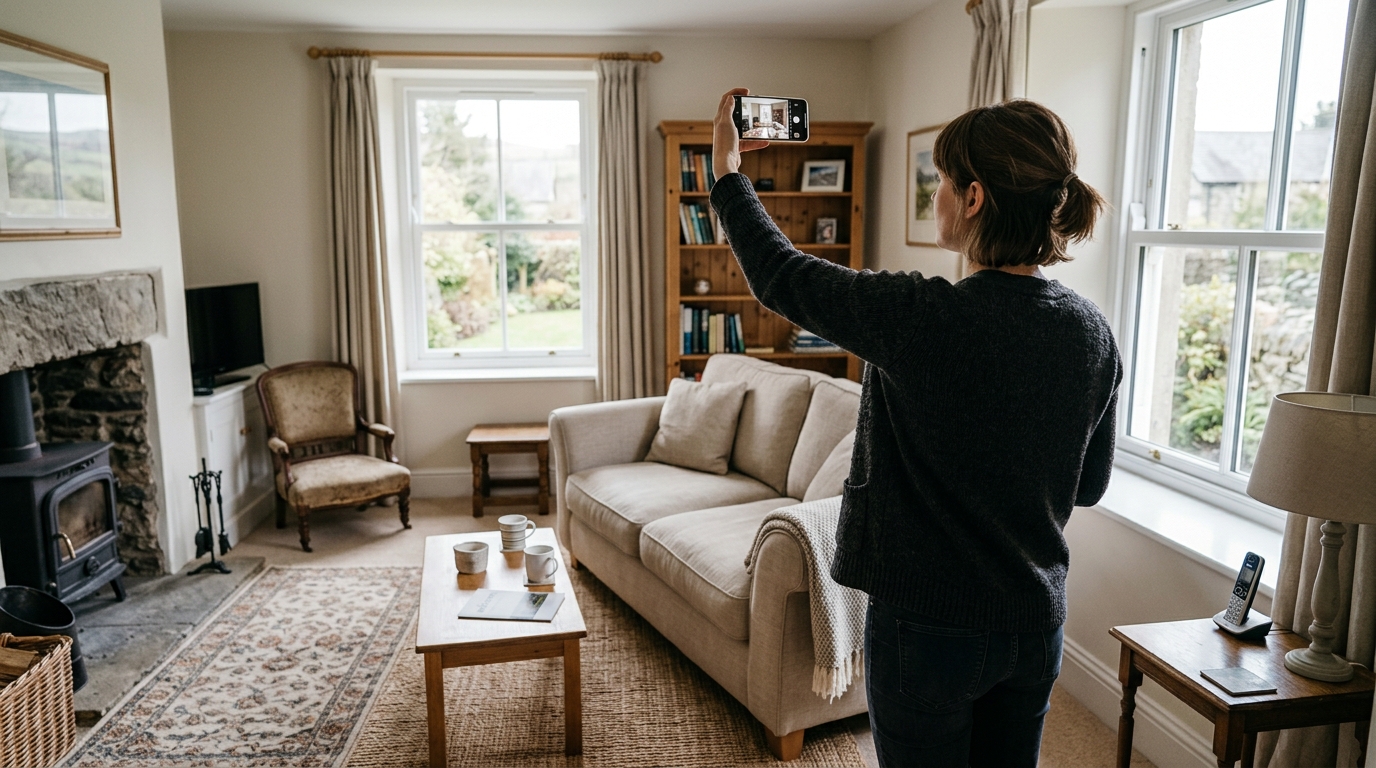
You can take pictures room by room or use a reel which is often quicker, reserving photos for fine detailing as an extra record. The fixtures and fittings most likely to become damaged include:
- sofas, armchairs, and mattresses
- the hob, the oven, and the worktops
- flooring, rugs, and stair carpet
- garden furniture and the hot tub surround
- anything painted white
Keep the photos and any film in the same location as the paperwork for these items, so that's the receipts and invoices for anything of value, model, and serial numbers which you photograph from the plate rather than type out, and the respective purchase dates. Airbnb's damage protection terms ask for precisely this: an inventory with make, model, purchase date, condition and estimated repair or replacement cost, plus proof of ownership. Keeping these records together makes submitting a claim quick and stress-free.
One detail is easy to get wrong. Photographs carry their own embedded record of when and where they were taken, and that is a large part of what makes them useful. It survives if the file is kept exactly as it came off the camera or the phone. It does not survive being sent through most messaging apps so you will lose the most vital record to support your claim.
Why a Changeover Log Is Your Most Valuable Record
The hardest thing to prove in a holiday let claim is not that damage occurred but when it happened and therefore, which guest caused it. Back-to-back bookings make it almost impossible to accurately prove when the damage occurred.
You can't rely on a subsequent guest complaining about a huge hole in the sofa as proof that it was caused by the previous occupants. However, you can solve this with a changeover log. For every turnaround, record:
- the date and time your cleaner arrived and left
- a short note on the condition of the property
- photographs of each room once it has been reset or a simple 'walkaround' reel
- anything that needed attention, and whether it was dealt with
A changeover log creates a boundary either side of every stay. Damage found on Tuesday sits between Sunday's changeover photographs and Tuesday's inspection, and which guest was responsible stops being a matter of conjecture.
Arrival and departure times do the same job from the other end. A keysafe code that changes with each booking, a smart lock, or simply the guest's own message telling you they have arrived, all give you a verifiable time you can rely on. But isn't this just another task to add to your endless list?
A good deal of routine admin can now be handled by software. Platforms like Zugrow hold the guest conversation, the arrival and departure times, and the changeover log against the booking, all timestamped as they happen, so the trail builds itself without anyone having to remember to do it.
It removes the most common failure of all, which is that the record was never made in the first place. Combine that with a quick walkaround with a mobile device at changeover and you have everything you need to support a credible claim for occupant damage.
Why Does Evidence Disappear?

Here are four perfectly ordinary situations which account for most of the gaps.
The conversation moved off the platform
A guest messages you on Airbnb, asks for a mobile number, and everything after that happens by text. The platform thread stops mid-sentence and the part where they mention the broken shower is sitting on somebody's phone.
Always keep the substantive exchanges on the platform including negative reviews and your response to the customer. At the very least drop a short summary of the phone call back into the platform thread afterwards.
The cleaner's photographs went through WhatsApp
This is the one nobody sees coming. Sending a photo as an image compresses it and strips out the embedded capture data, so what arrives is a picture with no reliable record of when it was taken.
Sending the same file using the attachment icon and choosing "Document" transmits it unchanged, with the metadata intact. It is a five second difference in habit and it is the difference between a photograph that dates itself and one that does not. Better still, have changeover photographs go somewhere that is not a personal phone at all.
The agreement was verbal
A guest owns up to the breakage on the doorstep, offers to pay, and then doesn't. Without something in writing, that conversation never happened.
A short message afterwards along the lines of "thanks for letting me know about the shower screen, I'll send the repair cost across once I have it" turns a doorstep chat into a record, without being heavy-handed or creating any awkwardness at all.
It was a direct booking
If you take bookings through your own website, there is no platform holding the thread for you, no resolution centre, and no deposit mechanism to support a damage claim.
Whatever you use for direct enquiries, you must be able to retain the correspondence in a location where you can retrieve it. Additionally, your terms need to be issued and acknowledged in writing rather than assumed.
Where Does Platform Protection Stop and a Policy Start?
Platform protection can be a helpful place to turn when the unexpected happens, but it is not a failsafe. Holiday let insurance is there to address the gaps by offering cover for loss of income while the property cannot be let, insuring the property between bookings, and providing extra protection through public liability.
What Does Your Insurer Need For A Claim?
When you call your insurer to make a claim, they will request all the information available regarding the damage at the property and its cause.
It's important to retain receipts or credit card statements, photographs, and correspondence with guests. Each of these can help you have a successful claim and is the same sort of information you would supply to your platform provider.
Frequently Asked Questions
Where do I download my Airbnb message history?
Go to Account, then Privacy and Sharing, then "Request your personal data". You can choose HTML, JSON, or spreadsheet format. Airbnb will email you when the file is ready. However, it's only available to download for a limited period, so save it somewhere permanent as soon as it arrives.
Do my photographs need to be dated?
A date makes them far more useful; most cameras and phones embed one automatically. The problem is that the embedded data is stripped out by most messaging apps, so a photograph that arrives by WhatsApp has usually lost its data. Keep the original file, or send it as a document rather than as an image.
What if I only find the damage weeks later?
The platform windows will usually have closed by then, which is why the changeover inspection matters so much. It is important to get in touch with your holiday let insurer as soon as you are aware of the damage. Some insurers require notification within a specified period, such as 30 days, so always check you are inspecting within their time limits.
How long should I keep all of this for?
If you've had no issues with a guest and you're well outside your platform's window for making a claim, you may want to delete records after 12 months. If you have a claim against an occupant, another type of dispute, or any concerns, always retain these records for at least three years.
Does a platform damage scheme count as insurance?
Damage schemes provided by platforms are not the same as comprehensive holiday home insurance. Insurance can cover bookings made outside the platform, damage between bookings and non-guest related events such as fire, storm, flood or burst pipes, as well as loss of rental income if you are unable to continue letting the property.
Is It Worth the Effort?
None of this takes long, and all of it is easier now than it will be in the middle of a busy August. If you do nothing else this week, do this:
- Request your personal data file from Airbnb, just to see what is in it.
- Take a baseline photograph set, room by room, and put the date in the folder name.
- Put receipts, model numbers and serial numbers for anything valuable into one place.
- Start a changeover log, even if it is only a shared note with a date, a time and four photographs.
- Ask your cleaner to send photographs as documents rather than as images.
- Check which of the three deadlines above applies to each of your listings.
A claim is not really decided at the point it's lodged; it's decided by whether the ordinary paperwork associated with running your property happens to be good enough. This is settled months earlier, by habit rather than by intention.
Top Tips to Takeaway
- Owners can stay up-to-date with reporting processes and timelines on their booking platform by diarising routine checks at regular intervals
- Understanding the information a booking platform holds about a property, how to access it, and being familiar with the layout helps prompt and effective action in a claim
- A visual time-stamped record of the key features of the property kept in a safe location alongside purchase receipts and data like model and serial numbers makes it easier to produce the information a platform or insurer needs
- Software tools can help create a timestamped evidential trail automating a lot of the legwork, saving time and protecting the owner's position
- Comprehensive holiday let insurance is more extensive than damage schemes provided by booking platforms
As an owner of a holiday let property, the last thing you want when dealing with unexpected damages is to find out you cannot claim. Making sure you have comprehensive home insurance, in addition to cover provided by platforms, will give you the best opportunity of having a successful and speedy claim to avoid missed bookings and unexpected expenses.
i4me's focus is on the holiday let market. They can help you choose the right policy for your specific requirements, whether you have a static caravan, a cosy period cottage, or a lodge, and will navigate the different products on offer to make sure you always have the cover you need. Contact i4me today.